
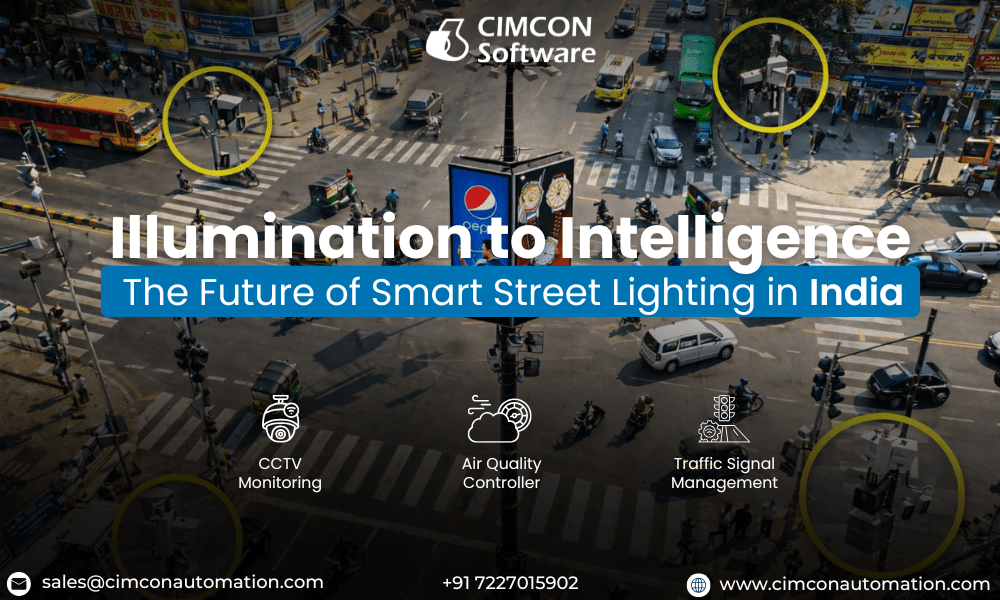
Advancing Public Safety Through Intelligent Street Lighting in India
Electric streetlights began appearing in Indian cities in the early twentieth century and gradually became a standard part of public infrastructure. Most systems operated on fixed schedules, and faults were usually identified only after complaints or routine inspections. Municipal authorities had limited visibility into performance, energy usage, or outage patterns, and lighting networks functioned largely as standalone utilities.
By 2015, the need for efficiency and better oversight led the Government of India to introduce large-scale modernization efforts. The Unnat Jyoti by Affordable LEDs for All accelerated LED adoption across the country, while the Street Lighting National Programme focused on replacing conventional streetlights in cities and towns. The programme was implemented by Energy Efficiency Services Limited, enabling structured upgrades at scale.
LED deployment reduced energy consumption and maintenance costs, but it also highlighted the absence of real-time control and operational visibility. Municipalities began seeking systems that could provide measurable accountability rather than just efficient fixtures. During the same period, pilot projects such as the Golden Mile corridor in Vijayawada demonstrated how street lighting could be integrated with surveillance and connectivity infrastructure, expanding its role within urban governance.
These developments marked the beginning of India’s transition from basic illumination toward connected, intelligent street lighting systems designed for efficiency, oversight, and public safety alignment.
Why Street Lighting Matters for Public Safety
Street lighting directly affects road safety, pedestrian movement, and overall public confidence after dark. Poorly lit stretches increase accident risk and create safety concerns, while consistent illumination improves visibility for drivers, walkers, and enforcement agencies.
Reliable lighting also supports emergency response by keeping routes visible for police, ambulances, and fire services. Surveillance systems depend on stable lighting conditions, making illumination a practical requirement for effective monitoring. During unexpected events or infrastructure failures, functioning streetlights help maintain order and continuity.
As cities demand greater accountability from public infrastructure, lighting systems are expected to provide reliability, fault visibility, and operational control. Illumination alone is no longer sufficient; performance and oversight now matter just as much.
From LED Adoption to Smart Controls
Modernization began with large-scale LED replacement to reduce energy use and maintenance costs. Programmes such as the Unnat Jyoti by Affordable LEDs for All and the Street Lighting National Programme enabled cities to upgrade significant portions of their lighting networks and achieve measurable savings.
Yet LEDs addressed efficiency, not visibility. Municipalities still lacked real-time insight into outages, performance, and system health. To close that gap, cities began adopting control systems that could monitor and manage lighting remotely.
This shift introduced connected lighting architectures built on digital communication and centralized platforms, turning streetlights into manageable infrastructure rather than static assets.
Group Controller Architecture
One widely adopted smart lighting model operates at the feeder level. In this architecture, a single controller manages a cluster of streetlights connected to the same electrical feeder. Instead of treating each pole as an independent node, the system supervises groups of lights collectively.
This approach is commonly deployed along highways, long urban corridors, industrial areas, and in semi-urban or rural networks where large stretches of lighting follow a linear layout. It is also suited to projects where scale and budget discipline are primary considerations.
Operational Advantages
Feeder-level control allows municipalities to switch clusters of lights on or off remotely and monitor overall circuit performance. The communication structure is simpler compared to pole-level systems, which supports faster deployment across extensive networks.
Because one controller governs multiple fixtures, the initial cost per light remains lower. For cities that do not require pole-specific diagnostics, this model provides structured oversight without the complexity of managing every individual luminaire. It offers a practical balance between modernization and cost efficiency.
Individual Light Controller Architecture
In this model, each streetlight is equipped with its own controller. Every pole function as an independent, connected node that can communicate its status to a central platform. Instead of managing clusters, the system monitors and controls lights individually.
This structure allows municipalities to switch lights on or off remotely, adjust brightness levels, and track performance at the pole level.
Where It Is Deployed
Pole-level control is typically implemented in dense city centers, high-sensitivity zones, and areas integrated with command-and-control systems. Locations with higher public movement, commercial activity, or security requirements often demand this level of granularity.
When lighting infrastructure is expected to work closely with CCTV networks, traffic systems, and public safety operations, individual control provides the required precision.
Operational Capabilities
Because each pole reports its own status, faults can be identified and located accurately without manual inspection. Real-time outage alerts reduce response time and improve maintenance planning. The availability of pole-level data also supports predictive maintenance and performance analysis.
For cities seeking measurable accountability and detailed operational insight, individual controller systems provide a structured and transparent approach.
Choosing the Right Architecture
Modernization efforts across India, including deployments nearing 40 lakh smart lighting nodes, show that architecture depends on use case. System design is driven by geography, density, safety priorities, and budget.
Highways and long corridors typically operate efficiently with group controllers. Dense city centers and command-and-control environments require pole-level systems for detailed monitoring. Residential areas often adopt hybrid models. Budget-conscious municipalities may begin with feeder-level monitoring and scale gradually, while high-security zones depend on individual control.
Deployment decisions now focus on operational requirements and measurable performance. Flexibility in architecture allows cities to align infrastructure with ground realities.
Smart Lighting Through Hybrid Integration
Many cities are moving toward hybrid deployments that combine feeder-level control with pole-level intelligence where required. Feeder monitoring provides network-wide energy oversight, while individual controllers are installed in critical or high-traffic zones that demand closer supervision.
These systems are typically connected to centralized dashboards that allow authorities to track performance, identify outages, and manage service workflows. Data collected from the network supports uptime monitoring and structured maintenance planning, often aligned with defined service-level agreements.
By combining both levels of control within a single framework, municipalities improve reliability and reduce response time without overengineering the entire network. Hybrid integration allows infrastructure to scale in line with operational priorities rather than applying uniform complexity across all areas.
Designing Lighting Systems Around City Requirements
As cities moved beyond LED replacement, the priority shifted to control, visibility, and scalability. CIMCON structures its smart lighting systems to address these operational needs.
The platform supports group controllers, individual pole-level controllers, and hybrid configurations within a unified framework. Centralized monitoring enables network oversight, while secure communication and analytics support fault detection and maintenance management.
Cities can deploy feeder-level or pole-level control based on geography, density, and safety priorities, and expand the system without restructuring the network. This approach keeps the architecture aligned with operational requirements rather than fixed deployment models.
Use Case: The Ahmedabad Blackout That Triggered a ₹500 Crore Rethink
During the tensions around Operation Sindoor, cities across India reviewed emergency blackout preparedness intended to reduce visibility during a potential aerial strike. In Ahmedabad, the exercise revealed how difficult that task becomes when lighting networks are not centrally controlled.
Ahmedabad operates more than two lakh streetlights across municipal zones. When authorities attempted the blackout, switching them off required coordination across contractors and scattered control points because the network lacked a single command system. The shutdown took nearly five hours.
The experience pushed the Ahmedabad Municipal Corporation to move toward a INR 500-crore streetlight automation program that would connect the city’s lighting infrastructure to a centralized platform capable of monitoring and controlling thousands of lights from one system.
The Ahmedabad drill showed how quickly a routine municipal asset can become a strategic infrastructure challenge when it cannot be controlled centrally. The same issue exists in many large cities where lighting networks were built for maintenance and coverage, not coordinated control. Automation platforms are now being adopted to connect these networks and allow citywide lighting to be monitored and managed through a single system.
The Next Phase of Smart Street Lighting with CIMCON
As smart lighting networks expand, the focus is shifting toward predictive maintenance, adaptive control, and integrated infrastructure management. CIMCON is aligning its platform to support these requirements.
Connected controllers generate performance data that helps identify potential failures before outages occur, improving maintenance planning and reducing downtime. Adaptive lighting enables brightness adjustments based on traffic patterns and usage conditions, supporting energy efficiency and safety.
Lighting poles are also being integrated with surveillance devices, sensors, EV charging infrastructure, and connectivity systems, all managed through centralized platforms with secure communication frameworks. Hybrid deployments combining feeder-level and pole-level control are being operated through unified dashboards.
The direction is focused on measurable performance, operational visibility, and scalable governance across distributed lighting networks.
Delivering Smart Lighting at Scale
India’s shift from conventional lighting to connected infrastructure has unfolded in phases. LED upgrades improved energy efficiency, but they also highlighted the need for real-time visibility, fault detection, and structured maintenance. As networks expanded, cities required systems that could adapt to highways, dense urban zones, industrial corridors, and security-sensitive areas without forcing a uniform model.
CIMCON has operated across every stage of this transition. Established in 1988, the company has helped deploy more than 1.2 million streetlight controllers in 24 countries, supporting lighting networks that serve over 54 million people and contributing to cumulative energy savings exceeding 1.5 billion kWh.
Its deployments include early smart lighting at GIFT City and large infrastructure projects such as Mumbai Trans Harbour Link, Vadodara Smart City, Hyderabad Outer Ring Road, and Kochi’s 40,000-light network in Kochi. Across these environments, feeder-level group control, pole-level diagnostics, and hybrid configurations have been implemented based on operational requirements.
As modernization progresses toward millions of connected streetlights, lighting infrastructure is being managed with measurable performance standards and defined service outcomes. Systems are expected to deliver efficiency, reliability, and oversight within a single scalable framework.