
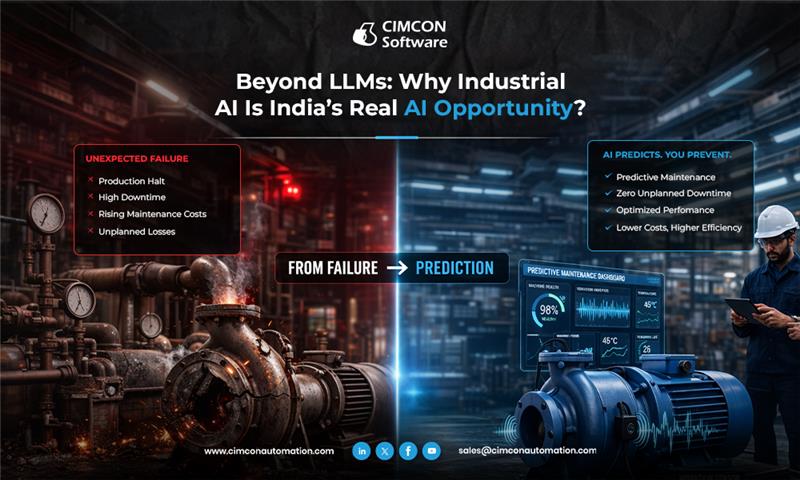
Beyond LLMs: Why industrial AI Is India’s real AI opportunity?
While we debate prompt engineering, agents and foundational models, a far more consequential form of AI is needed on factory floors, inside power grids, and across our water distribution networks.
Consider, a centrifugal pump at a manufacturing plant in Gujarat that fails without warning. Production halts, maintenance crews scramble, and the cost runs into lakhs even crores. Now, consider an alternative: an AI system trained on vibration, temperature, and acoustic data that had already identified a bearing fault a week earlier and flagged it for maintenance. The pump never failed! This is industrial AI!!
However, unfortunately this is not the type of AI that dominates our boardroom or policy conversations. When we look at today’s technology discussions in India at industry forums, policy briefings, or investment summits, the focus is almost entirely on sovereign large language models, GenAI, and building India’s equivalent of ChatGPT.
It is a legitimate ambition, but an incomplete one. While we debate prompt engineering, agents and foundational models, a far more consequential form of AI is needed on factory floors, inside power grids, and across our water distribution networks.
This form of AI is industrial AI. Its impact on India’s technological and economic future is immense. Our manufacturing sector contributes 17% of national GDP today, and it needs to reach 25% by 2030 to get to our goal of becoming the third largest global economy. This will not happen by just adding more workers or installing more machines alone.
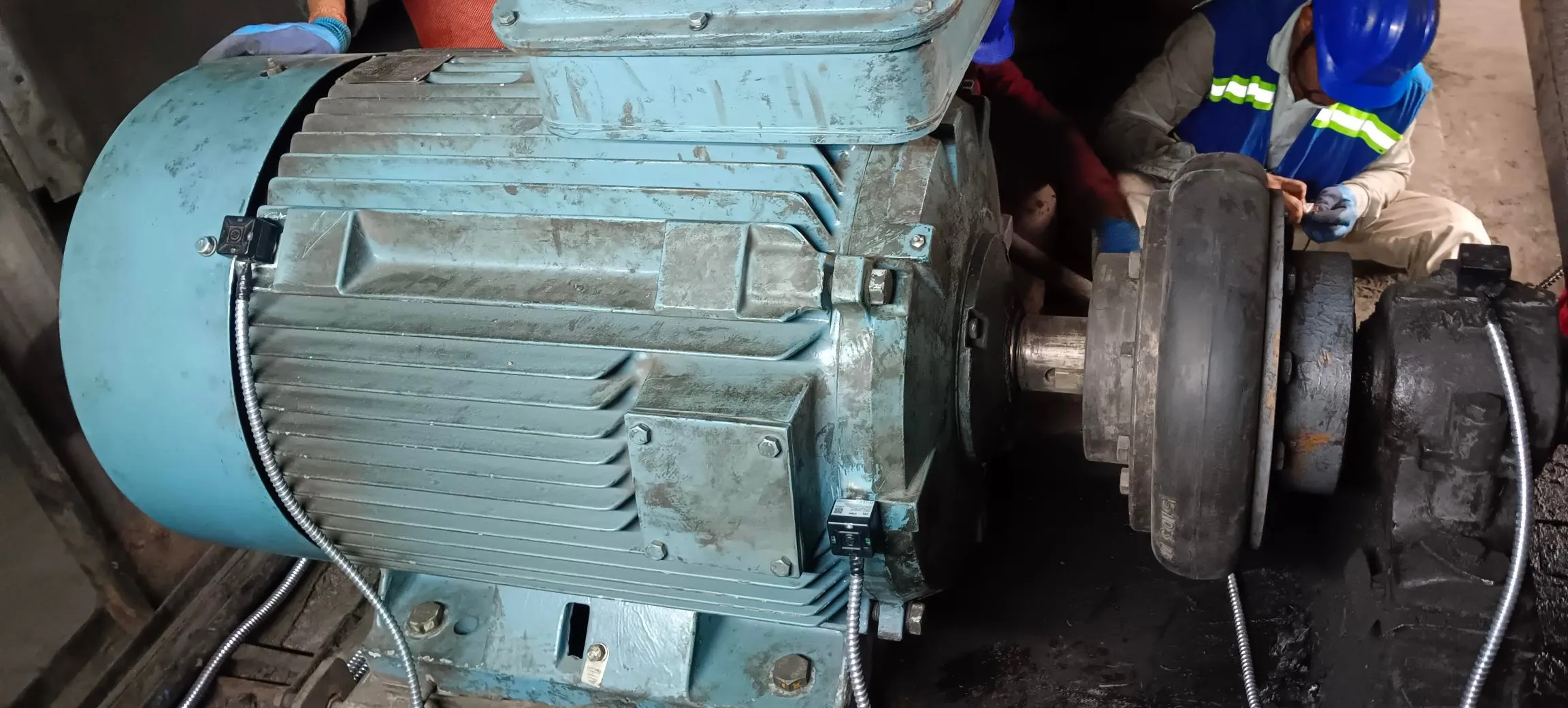
We will need smart factories that use self-correcting, AI-driven infrastructure. Technology to make this happen exists today. All we need is focus and realization that Industrial AI is the real AI opportunity.
Industrial AI is a different discipline entirely
Let us first understand what it takes to build Industrial AI, because it is fundamentally different from building a GenAI product. Creating a GenAI model primarily requires compute power, data, and software engineering talent. Industrial AI requires all of that, plus something far harder to acquire, deep domain knowledge.
To build a model that predicts failure in a centrifugal pump, you must understand how cavitation behaves under variable flow conditions. To build an AI system that monitors an electrical grid, you need working knowledge of electromagnetics and power distribution. These disciplines, spanning fluid mechanics, thermodynamics, structural engineering, material science, and power engineering, have taken engineers decades to master.
And, here is the real challenge! The people running our manufacturing industries typically lack knowledge of AI, and people who understand AI have little to no understanding of industrial processes. Bridging this gap requires cross functional teams that respect each other’s expertise.
However, this is not the only challenge. For AI to be effective it has to be trained on real data. Unlike GenAI, Industrial AI cannot be trained with internet data. It runs on sensor data, readings from pressure, temperature, flow acoustic and vibration sensors. A vibration sensor alone generates approximately 25,000 samples per second, data that must be processed using FFT. This is why Industrial AI is harder and slower to build and precisely why it is more defensible once built.
Real-world impact is already measurable
The value of Industrial AI is not theoretical. Predictive maintenance systems prevent unplanned downtime and improve production continuity, energy efficiency, and machine lifespan. Manufacturing operations that have deployed Industrial AI report meaningful reductions in energy consumption and emissions through operational optimization alone. The same equipment performs better, with less waste, without capital replacement.
For India, this matters enormously. Our manufacturing base runs largely on aging machinery pushed close to capacity to meet rising demand. Replacing that equipment is capital-intensive and slow. Making existing equipment smarter is not. With edge computing, wireless networks, and sensor technology advancing rapidly, the economics of industrial intelligence are becoming viable at scale.
The same logic applies to our utilities and public infrastructure. Water distribution networks, electrical grids, and urban systems degrade over time and manual monitoring is expensive. Remote monitoring powered by Industrial AI delivers uninterrupted service at a fraction of the cost. The intent is already visible in India’s smart city initiatives, smart streetlights, water management, and grid monitoring. The common thread through all of them is Industrial AI.
India checks every box for industrial AI leadership
First, we have one of the largest engineering talent pools in the world, trained in the mechanical, electrical, and electronics disciplines that Industrial AI demands. Second, we already have a growing base of over 600,000 AI professionals who have honed their skills building products for global companies.
Third, our manufacturing sector is under real pressure to perform at global standards and is actively looking for the tools to do it. Fourth, and most importantly, we have data flexibility. India’s regulatory environment around industrial data remains relatively open, giving us access to the manufacturing datasets essential for training AI models, access that other countries are already restricting.
No other country combines all these four elements. That is not a minor advantage. That is the foundation for building the next generation of industrial technology companies whose products could run factories, utilities, and infrastructure systems across the globe.
The window is now
The global AI race has become fixated on who will build the next large language model. India does not need to win that race. We need to run a different one. The opportunity is in our factories, our power grids, our water systems, and our urban infrastructure. These are physical, complex, and uniquely suited to the deep engineering strengths we already have.
Industrial AI is hard to build and slow to mature, but that is exactly why whoever starts today builds a durable lead. India has the talent, the demand, the data, and the urgency. What we need now is the conviction to direct our AI investments toward the physical world, not just the digital one.
The next Microsoft of the industrial world will not come from Silicon Valley. It can come from India, if we make that choice today.
— Anil Agrawal, Founder and CEO, CIMCON Automation.
Source :- We are proud to have been featured by Dataquest. The original article is republished below with permission.