
Introduction: Transition from Reactive to Intelligent Operations
The oil and gas sector operates within highly complex, capital-intensive environments where asset reliability is critical to both safety and profitability. Historically, operations have relied heavily on manual inspections and reactive maintenance practices, resulting in delayed fault detection and limited operational visibility.
With assets exposed to extreme pressures, temperatures, and corrosive environments, even minor anomalies can escalate into significant operational disruptions, environmental risks, and financial losses. This necessitates a shift toward continuous monitoring and early fault detection.
Digital transformation is enabling this transition by introducing real-time intelligence across the asset lifecycle. By leveraging connected systems and data-driven insights, operators can now move beyond delayed responses toward proactive and predictive decision-making.
Digitalization in Oil & Gas Operations
The integration of digital technologies is fundamentally redefining asset monitoring and operational control within the oil and gas industry.
IoT-enabled sensors provide continuous, real-time visibility into equipment health and performance parameters. Remote monitoring systems reduce dependency on physical inspections, particularly in geographically dispersed and hazardous environments. Automation ensures process consistency, regulatory compliance, and reduced human intervention.
Furthermore, the adoption of AI and machine learning models enables predictive maintenance by identifying patterns and anomalies before failures occur. This shift from reactive to proactive operations significantly minimizes downtime, optimizes maintenance cycles, and enhances overall asset reliability.
Corrosion Management: Addressing a Critical Infrastructure Risk
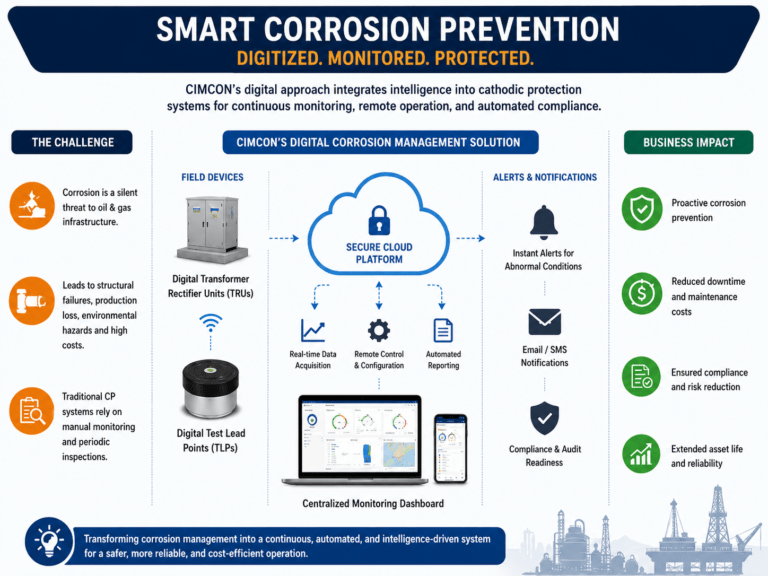
Corrosion remains one of the most persistent and costly challenges in oil and gas infrastructure. Pipelines, storage tanks, and processing units are continuously subjected to harsh chemical and environmental conditions, making them highly susceptible to degradation.
If not effectively managed, corrosion can lead to structural failures, environmental hazards, production interruptions, and substantial repair or replacement costs.
Cathodic Protection (CP) systems are widely deployed to mitigate corrosion. However, traditional CP implementations often rely on manual monitoring and periodic inspections, resulting in inefficiencies, delayed responses, and potential compliance gaps.
CIMCON’s Digital Approach to Corrosion Prevention
CIMCON introduces a digitized approach to corrosion management by integrating intelligence into cathodic protection systems. This enables continuous monitoring, remote operation, and automated compliance management.
The solution architecture supports real-time monitoring of CP parameters, remote control of transformer rectifier units (TRUs), automated reporting, and instant alert generation for abnormal operating conditions.
Key Components
Digital Transformer Rectifier Units (TRUs)
These are microprocessor-based, SMPS-powered systems designed for high reliability in harsh environments such as offshore platforms, deserts, and arctic regions. They support remote monitoring, multi-channel control, and precise regulation of protection parameters.
NextGen AI Test Lead Points (TLPs)
These are wireless, GSM-enabled monitoring devices that automate data acquisition and logging. They enable real-time AC/DC interference detection and eliminate the need for manual inspection processes.
Together, these components transform corrosion management into a continuous, automated, and intelligence-driven system, significantly improving operational efficiency and asset protection.
Intelligent Monitoring of Rotating Equipment: VIBit-BP ATEX
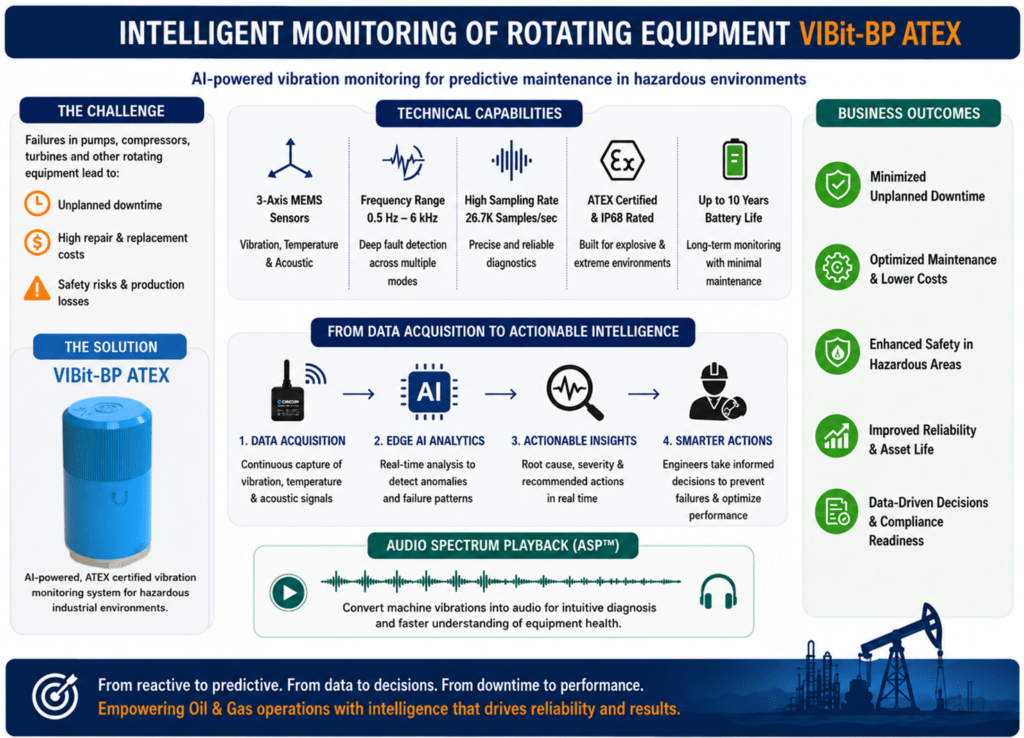
Beyond infrastructure corrosion, failures in rotating equipment such as pumps, compressors, and turbines are a major contributor to unplanned downtime.
CIMCON addresses this challenge through VIBit-BP ATEX, an advanced AI-powered vibration monitoring solution specifically engineered for hazardous industrial environments.
Unlike conventional sensors, VIBit functions as an intelligent diagnostic system that continuously analyzes machine behavior in real time.
Technical Capabilities
The system is equipped with 3-axis MEMS sensors capable of capturing vibration, temperature, and acoustic signals. It operates across a wide frequency range, enabling deep fault detection across multiple failure modes.
With a high sampling rate, the system ensures precise diagnostics. Its ATEX certification makes it suitable for explosive environments, while its IP68 rating ensures durability in extreme industrial conditions. Additionally, the device supports up to 10 years of battery life, enabling long-term deployment with minimal maintenance.
From Data Acquisition to Actionable Intelligence
Traditional maintenance strategies are schedule-driven and often fail to capture real-time asset conditions. VIBit transforms this approach by enabling condition-based and predictive maintenance.
Real-Time Fault Detection
Edge AI models continuously analyze machine behavior to detect conditions such as imbalance, misalignment, bearing defects, cavitation, and structural looseness.
Actionable Insights
The system provides not just raw data, but meaningful insights including root cause identification, fault severity classification, and recommended maintenance actions.
Audio Spectrum Playback (ASP™)
A unique capability that allows engineers to interpret machine conditions through audio signatures, enabling detection of anomalies that may not be visible through conventional analysis.
Intelligent Wake-on-Anomaly
The system optimizes power and communication efficiency by activating only when anomalies are detected, thereby conserving battery life and reducing network load.
Application Across the Oil & Gas Value Chain
CIMCON’s solutions deliver value across upstream, midstream, and downstream operations.
In upstream operations, they enable monitoring of artificial lift systems and compressors, ensuring production continuity and minimizing unplanned shutdowns.
In midstream, they support monitoring of pipeline compressor stations and pumping systems, helping prevent leaks and maintain throughput stability.
In downstream operations, they ensure reliable performance of pumps, turbines, and critical refinery equipment, thereby maintaining process stability and avoiding costly disruptions.
Business Impact
These solutions collectively deliver measurable outcomes, including a 30–50% reduction in unplanned downtime and a 20–40% reduction in maintenance costs, while extending asset life and improving operational reliability.
Eliminating Operational Blind Spots
A key challenge in oil and gas operations is the lack of visibility across distributed and remote assets.
CIMCON addresses this through integrated digital platforms that provide remote dashboards accessible via web and mobile interfaces. The system leverages secure cloud infrastructure and store-and-forward communication to ensure data continuity even in low-connectivity environments.
Additionally, video analytics capabilities enhance safety by enabling real-time detection of fire, intrusion, and human presence in restricted zones.
This comprehensive visibility ensures that all critical assets are continuously monitored, regardless of location.
Sustainability and Net-Zero Alignment
Digitalization in oil and gas is not only improving operational efficiency but also contributing to sustainability goals.
Optimized operations reduce energy consumption, while predictive maintenance minimizes emissions associated with unexpected failures and shutdowns. Extended asset lifecycles further reduce material waste.
CIMCON supports these objectives through solar-powered RTUs and TLPs, AI-driven energy optimization, and digital twin-based predictive maintenance strategies, aligning operational performance with environmental responsibility.
Conclusion: Enabling Predictive and Intelligent Operations
The oil and gas industry can no longer depend on delayed insights and manual intervention. The future of operations lies in connected, intelligent ecosystems where assets continuously communicate their condition, and failures are anticipated before they occur.
By integrating smart corrosion prevention systems with AI-powered asset intelligence such as VIBit-BP ATEX, CIMCON enables a transition from reactive maintenance to predictive and prescriptive operations.
This transformation goes beyond digital adoption. It represents a fundamental shift toward safer, more reliable, and sustainable industrial operations.