
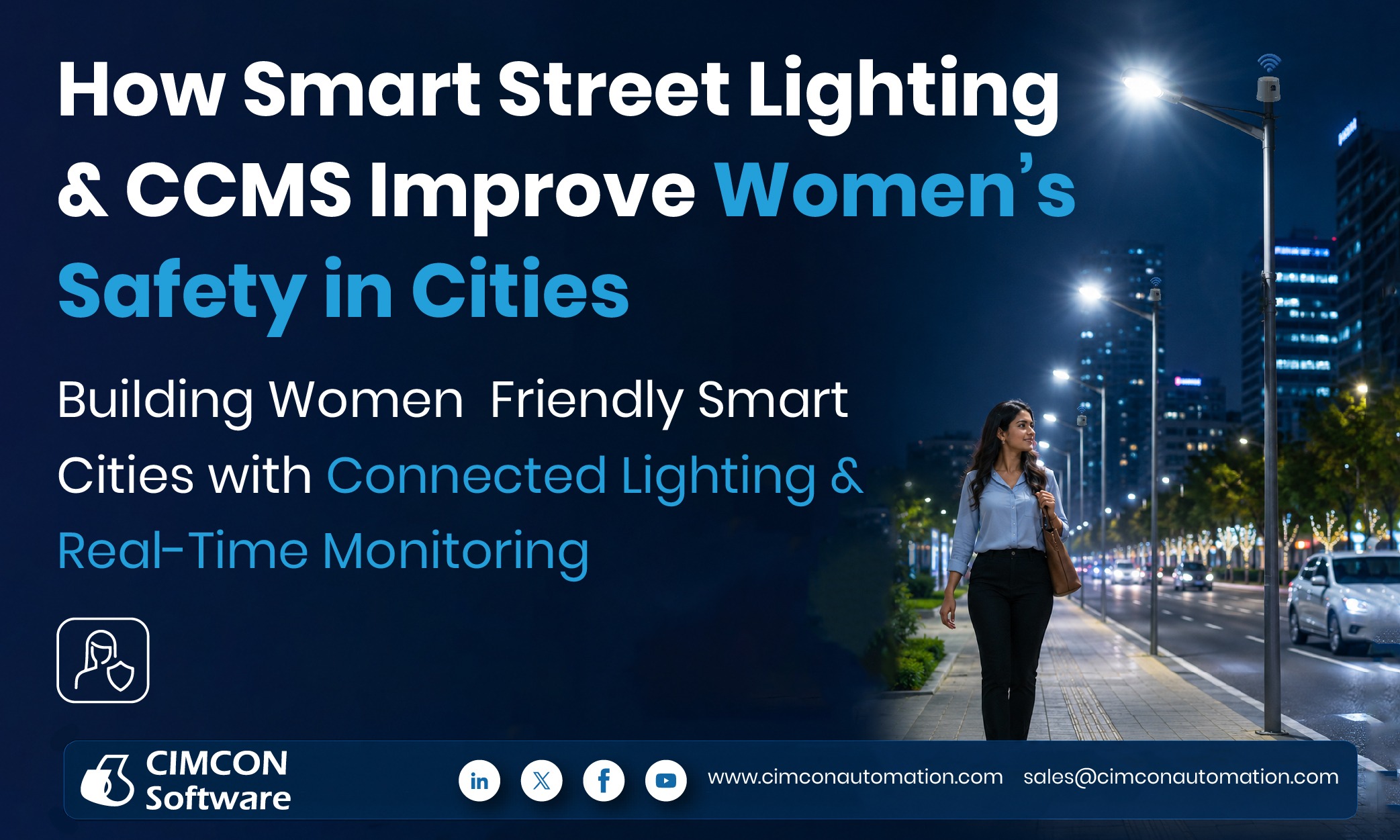
As cities grow denser and nightlife extends later into the evening, the question of who feels safe moving through public space after dark has become impossible to ignore. For city planners and municipal authorities, women’s safety is no longer a peripheral concern—it is central to how livable, inclusive, and modern a city can claim to be. And increasingly, one of the most practical answers lies overhead, on the poles that line every street: intelligent lighting.
Smart Street Lighting paired with Centralized Control & Monitoring Systems (CCMS) is quietly transforming ordinary streetlights into responsive urban infrastructure. These systems improve visibility, strengthen surveillance, and enable faster emergency response—turning a passive utility into an active layer of public safety.
From Simple Illumination to Intelligent Infrastructure
For most of their history, streetlights did one thing: they turned on at dusk and off at dawn. When a lamp failed, it often stayed dark for days or weeks until someone reported it. Poorly lit streets, malfunctioning fixtures, and slow maintenance created pockets of the city that felt unsafe—exactly the kind of places that discourage women from traveling confidently at night.
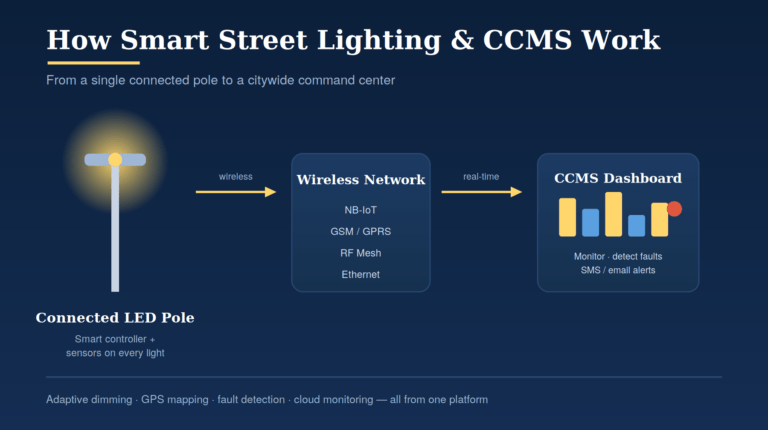
Modern smart lighting flips that model on its head. Connected LED streetlights, fitted with intelligent controllers, can be monitored and managed remotely in real time. Using wireless communication technologies such as NB-IoT, GSM/GPRS, RF Mesh, or Ethernet, city authorities can instantly spot lighting failures, track energy usage, and operate streetlights from a single centralized platform. Capabilities like adaptive dimming, GPS mapping, real-time alerts, and fault detection mean the infrastructure itself flags problems before residents ever have to.
The Role of CCMS: One Dashboard, the Whole City
At the heart of this transformation is the Centralized Control & Monitoring System. CCMS gives city administrators a single dashboard from which to oversee an entire streetlight network. Rather than waiting on manual inspections or public complaints, the system automatically detects faults—lamp failures, feeder issues, voltage abnormalities, or full power outages—and pushes instant notifications to maintenance teams via SMS or email.
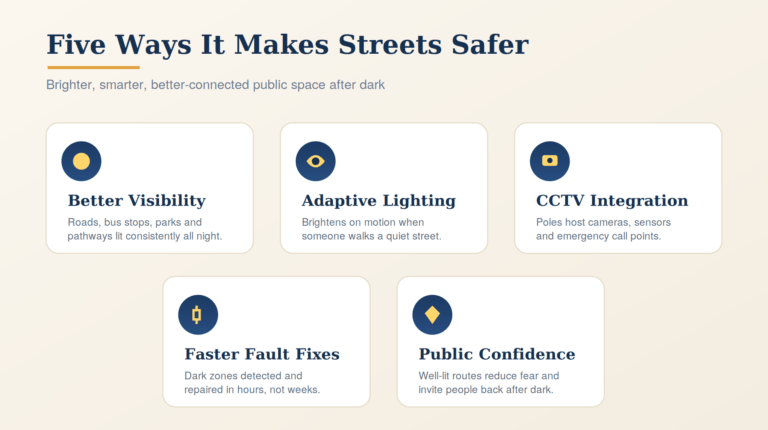
The practical effect is simple but powerful: dark zones get fixed faster. The window between a light going out and a light coming back on shrinks from days to hours, keeping the city’s safety net intact.
Why Better Lighting Matters for Safety
The immediate benefit is visibility. Bright, consistent LED lighting keeps roads, bus stops, parks, pedestrian pathways, and parking areas well illuminated through the night. That visibility does more than help drivers and pedestrians see—it builds confidence. A well-lit street feels less threatening, and isolated areas lose much of the fear that keeps people away from them after dark.
Smart systems go a step further with adaptive lighting. Streetlights can automatically adjust brightness based on movement, traffic density, or time of day. When motion is detected on a quiet street late at night, the lights can brighten in response—improving safety for a woman walking alone—then dim again to conserve energy when the area is empty. Intelligent illumination puts light exactly where and when it’s needed.
Connecting Lights to the Broader Smart City
Streetlight poles are everywhere, evenly spaced, and already wired for power—which makes them ideal hosts for additional safety technology. Smart lighting infrastructure can integrate with CCTV cameras, emergency call systems, motion sensors, and citywide command centers. Platforms designed for this purpose let streetlight networks support advanced applications such as real-time monitoring and edge analytics. In effect, each pole becomes an intelligent urban asset that expands surveillance coverage and sharpens emergency response.
Proof on the Ground
These aren’t theoretical benefits—cities have already put them to the test.
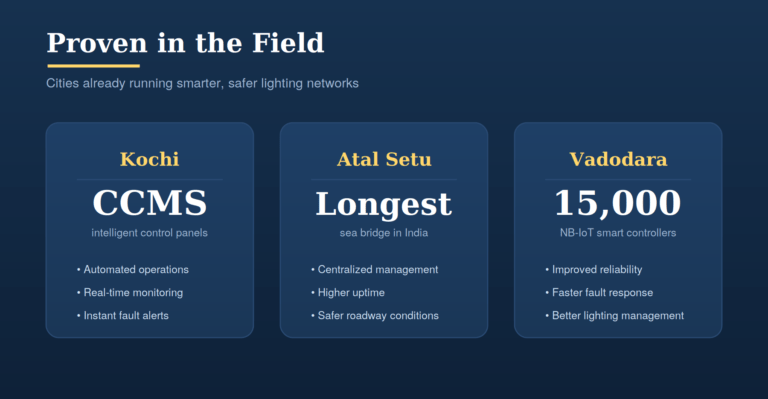
In Kochi, intelligent CCMS panels enabled automated lighting operations, real-time monitoring, and instant fault alerts, improving public safety while cutting maintenance costs.
The Atal Setu project deployed CCMS technology across India’s longest sea bridge, delivering real-time monitoring, automated fault detection, and centralized management. The result was higher uptime, better operational efficiency, and safer roadway conditions.
Vadodara modernized its lighting by installing 15,000 NB-IoT-based smart streetlight controllers, boosting reliability, enabling faster fault response, and streamlining overall lighting management.
What the Public Is Asking For
Ask anyone who walks home after dark and the answer is the same: well-lit streets feel safer and poorly lit ones do not. That instinct shapes the choices people make every day—which route to take, which station to use, whether to walk at all. For women in particular, lighting often decides whether a public space feels usable after sunset or simply off-limits.
Cities that take this seriously are recognizing that lighting is no longer a back-end utility but a frontline part of urban safety. Adaptive lighting, CCTV-integrated poles, and automated monitoring are increasingly seen as the baseline expectation for modern public space, not optional add-ons. The demand is there; the technology is simply meeting it.
Safety That Pays for Itself
The case for smart street lighting isn’t only about safety. Cities adopting LED fixtures and intelligent controls have achieved meaningful energy savings, lower operational costs, and reduced carbon emissions, all while improving maintenance efficiency and service quality. In other words, the same investment that makes streets safer also makes them cheaper and greener to run—a rare alignment of social and fiscal benefit.
Building Cities Where Everyone Feels Safe
As urban areas evolve into connected, data-driven ecosystems, smart street lighting and CCMS are becoming foundational public infrastructure rather than optional upgrades. They help municipalities optimize operations, yes—but more importantly, they create environments that are safer, more secure, and more inclusive for women and for every resident.
The shift is fundamental. Smart lighting is no longer just about pushing back the dark. It is about enhancing quality of life and building communities where people feel safe, confident, and connected at every hour of the day.
Learn more about intelligent lighting solutions at the CIMCON Lighting official page.