Industrial AI Solutions
The next frontier of infrastructure management is not just connectivity — it is intelligence. CIMCON’s Industrial AI delivers predictive insights, autonomous decision-making, and self-optimising systems for water utilities, smart city lighting, and oil & gas networks. Built on 35+ years of domain engineering, our AI is purpose-built for the physical world.
Reactive Maintenance Only
Field teams respond to failures after they occur, causing unplanned downtime, emergency costs, and service disruptions across water and lighting networks.
No Actionable Data Insights
SCADA systems collect vast data but lack intelligence to convert raw readings into early warnings, fault predictions, or operational decisions.
High Field Operation Costs
Dispatching technicians to remote assets without knowing the fault wastes time and inflates operational budgets — especially across large-scale networks.
Energy Wastage
Lighting, pumping, and pipeline systems often run at fixed schedules regardless of real demand, wasting significant energy and increasing carbon footprint.
Compliance & Audit Gaps
Manual reporting for JJM, AMRUT 2.0, and PSU audits is error-prone and time-consuming without automated data trails and real-time logs.
Legacy Infrastructure Limitations
Existing assets and SCADA systems lack built-in AI — upgrading requires solutions that layer intelligence without ripping out or replacing working infrastructure.
Edge AI — Intelligence at the Asset
AI logic runs locally on our field controllers without cloud dependency. Critical decisions are made in real time, even in low-bandwidth and remote environments.
Domain-Trained AI Models
Models trained on decades of water, lighting, and oil & gas operational data — delivering far higher accuracy than general-purpose AI for industrial use cases.
Automated Alerting & Work Orders
When AI detects an anomaly or predicts failure, the system automatically escalates to the right team and triggers maintenance work orders — minimising response time.
Seamless SCADA Integration
AI-powered insights surface directly in your existing CIMCON SCADA dashboards. No rip-and-replace. No new learning curve for your operations team.
Edge AI Controllers
AI processing at the field device level — no cloud dependency for critical decisions. Works offline in remote and low-connectivity environments.
Predictive Anomaly Detection
ML models identify equipment degradation, energy anomalies, and leakage patterns weeks before failure occurs — enabling proactive intervention.
Real-Time Alert Engine
Rule-based and ML-driven triggers escalate issues instantly to the right team with automated work order creation and logging with time-stamping.
Multi-Protocol Connectivity
Supports NB-IoT, LoRaWAN, LTE, GPRS, RS-485, Modbus, and satellite — compatible with both greenfield deployments and legacy infrastructure.
Compliance-Ready Reporting
AI-generated audit logs and reports structured for JJM, AMRUT 2.0, Dam Safety Act 2021, Smart Cities Mission, and PSU compliance frameworks.
SCADA & Dashboard Integration
AI insights surface directly in your existing CIMCON SCADA environment — operators see actionable intelligence without changing the tools they already use.

Improves
Reliability
- Predicts failures before they happen
- Enables 24/7 autonomous monitoring
- Reduces mean time to repair
- Eliminates surprise outages

Saves
Money
- Reduces unplanned downtime costs
- Lowers field visit expenses
- Optimises energy consumption
- Extends asset working life

Helps the
Environment
- Cuts energy waste at system level
- Meaningfully reduces carbon footprint
- Supports ESG reporting
- No capital replacement needed

Supports
Compliance
- Automated audit trail generation
- JJM and AMRUT 2.0 aligned
- PSU & Dam Safety Act ready
- Smart Cities Mission compatible
CIMCON's Impact Across Globe
72+
Towns and cities with CIMCON's intelligent infrastructure
29
Countries with CIMCON IoT and AI deployments globally
35+
Years of domain expertise now enhanced with AI
46M+
People with access to clean water through Smart Water solutions
Industrial AI Across Three Critical Infrastructure Domains
CIMCON’s Industrial AI is not a single product — it is a capability embedded across our entire solution portfolio, tailored to the unique operational needs of each infrastructure vertical.
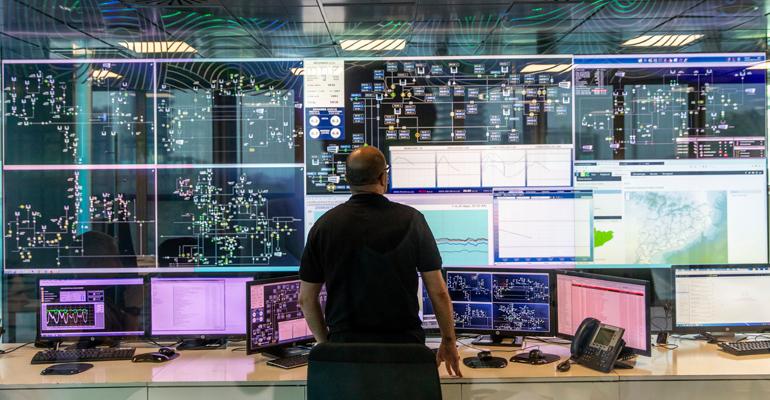
Water utilities face a dual challenge — aging pipelines that leak and growing demand for reliable, 24×7 supply. CIMCON’s AI-powered water management solutions turn your SCADA data into a predictive intelligence engine.
- Detect hidden leaks by analyzing pressure and flow patterns to reduce Non-Revenue Water (NRW).
- Identify bearing wear, cavitation, and pump issues before failures occur.
- Predict water demand to optimize supply schedules and reservoir operations.
- Monitor turbidity, chlorine, and pH in real time with instant AI alerts.
PROVEN RESULT
Nagpur water utility reduced Non-Revenue Water from 40% to 29% using CIMCON’s smart monitoring and AI-assisted leak correlation platform.
Learn more about CIMCON’s Smart Water→

Managing thousands of streetlight nodes across a city is operationally complex. CIMCON’s AI-enhanced CCMS shifts lighting management from reactive repairs to predictive, data-driven operations.
- Detect luminaire failures early using AI-powered performance analysis.
- Automatically adjust lighting based on traffic, daylight, and seasonal patterns.
- Prioritise maintenance with AI-driven health scores for every controller.
- Generate accurate compliance and energy audit reports instantly.
PROVEN RESULT
Hyderabad ORR achieved 40% energy savings and 50% maintenance cost reduction. Vadodara’s NB-IoT network saves 3.5 million kWh annually across 15,000 controllers.
Learn more about CIMCON’s Smart Lighting Solutions →

Pipeline integrity, pump performance, and corrosion control in oil & gas environments require continuous monitoring at scale. CIMCON’s Industrial AI brings intelligence to remote, high-stakes infrastructure.
- Detect cathodic protection anomalies early to prevent pipeline corrosion.
- Analyse dynagraph data to identify pump-off conditions and mechanical faults.
- Detect pressure, flow, and valve anomalies for faster leak and blockage identification.
- Dispatch field teams only when AI identifies critical issues.
PROVEN RESULT
IOCL deployed CIMCON’s cathodic protection monitoring system across a 3,000 km pipeline network — enabling real-time corrosion monitoring and reducing field inspection costs.
Learn more about CIMCON’s Oil & Gas Solutions →
INDUSTRY RECOGNITION
As Covered By Leading Industry Publications
CIMCON’s Industrial AI work and thought leadership have been featured and cited by India’s most respected technology, energy, and industrial media.
BISINFOTECH
CIMCON champions Physical Intelligence — embedding AI into pumps, motors, and critical assets to achieve true operational autonomy beyond data monitoring.
DATAQUEST INDIA
India’s real AI opportunity lies on factory floors, power grids, and water networks — not just in large language models. CIMCON’s deployments are leading examples.
INDUSTRIAL AUTOMATION INDIA
Deep-dive on how Industrial AI powers India’s manufacturing ambitions through smart Sense → Respond → Think & Improve systems.
THE HINDU
Why India’s automation education must evolve to build the interdisciplinary talent needed for Industrial AI at national infrastructure scale.
Case Studies
Smart Lighting Automation FAQs: Systems, Benefits & Technology
1. What is smart lighting?
Smart lighting refers to an intelligent lighting system that uses IoT, sensors, and centralized control platforms to monitor and manage lighting infrastructure. It enables automated operation, remote control, and energy optimization.
2. How does smart street lighting work?
Smart street lighting systems use controllers installed on streetlights, connected to a central management system. These controllers enable remote switching, dimming, scheduling, and real-time monitoring of lighting assets.
3. What are the benefits of smart lighting systems?
Smart lighting systems reduce energy consumption, lower maintenance costs, improve operational efficiency, and enhance public safety. They also enable better visibility and optimized lighting performance.
4. What is a Centralized Control and Monitoring System (CCMS)?
CCMS is a platform that provides centralized monitoring and control of street lighting networks. It allows operators to manage lighting schedules, monitor faults, and analyze energy usage from a single interface.
5. Can smart lighting systems be controlled remotely?
Yes, smart lighting systems can be remotely monitored and controlled through cloud-based platforms. Operators can manage lighting schedules, dimming levels, and fault detection from anywhere.
6. How does smart lighting help in energy savings?
Smart lighting systems optimize energy usage by dimming lights during low-traffic hours, automating schedules, and eliminating unnecessary operation. This significantly reduces electricity consumption and costs.
7. What role do IoT devices play in smart lighting?
IoT-enabled lighting controllers collect data and communicate with central systems. They enable real-time monitoring, remote control, and automation of lighting operations.
8. Is smart lighting suitable for smart cities?
Yes, smart lighting is a key component of smart city infrastructure. It enhances urban efficiency, reduces energy usage, and supports integrated city management systems.
9. Can existing street lighting infrastructure be upgraded to smart lighting?
Yes, existing lighting systems can be retrofitted with smart controllers and communication modules. This allows cities to upgrade to smart lighting without replacing the entire infrastructure.
10. What communication technologies are used in smart lighting systems?
Smart lighting systems use communication technologies such as NB-IoT, LoRa, RF, LTE, and PLC depending on the deployment requirements and network conditions.
11. How does smart lighting improve maintenance efficiency?
Smart lighting systems provide real-time fault detection and alerts. This helps maintenance teams quickly identify and resolve issues, reducing downtime and improving service reliability.
12. What is the ROI of smart lighting solutions?
The ROI comes from reduced energy consumption, lower maintenance costs, and improved operational efficiency. Most deployments achieve significant cost savings within a short period.
Resources

Case Study

Whitepaper

Brochure