
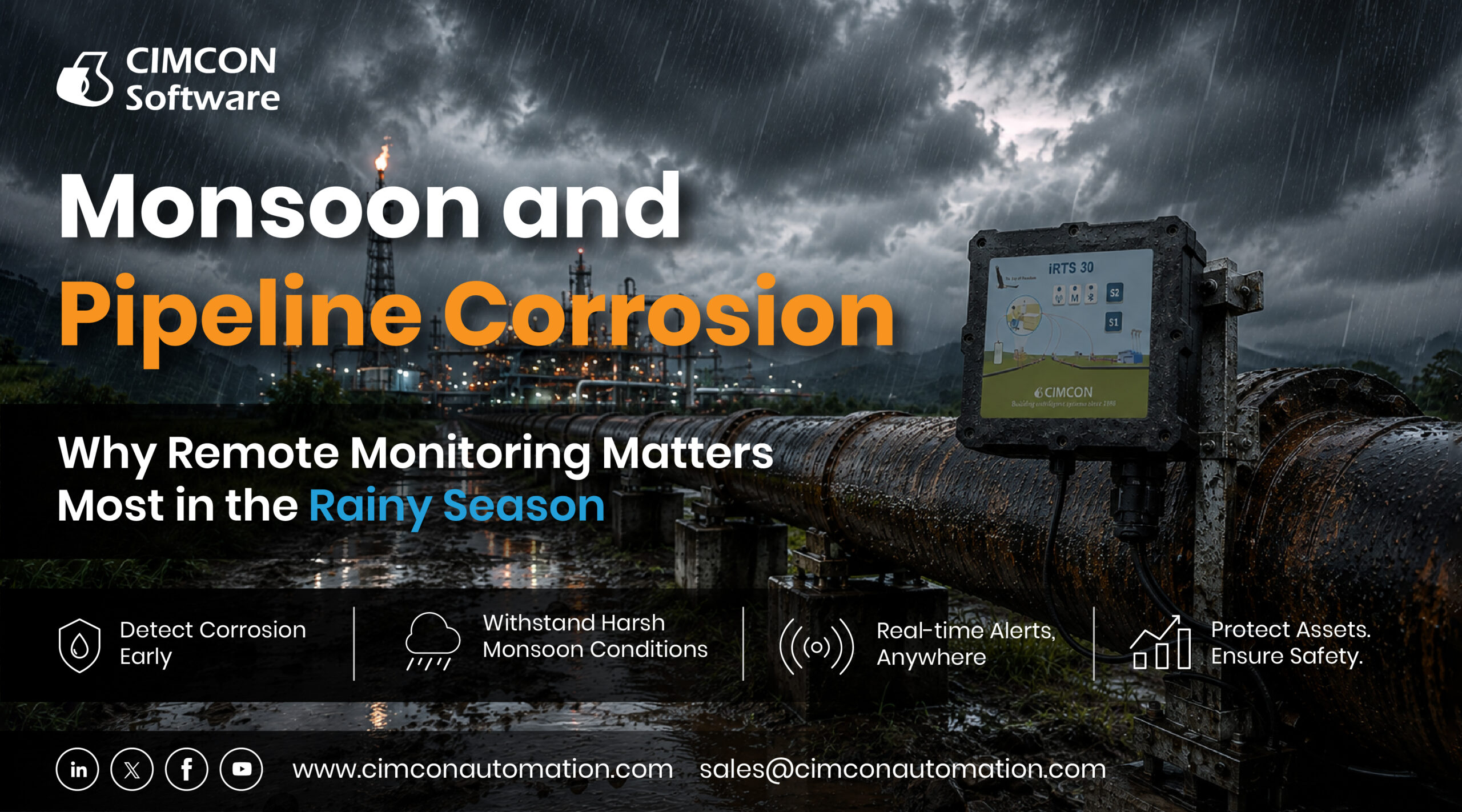
Every year during monsoon, India’s underground pipelines face their toughest test. Rainwater soaks into the soil around pipelines, and wet soil speeds up rusting — right at the time of year when it’s hardest for field teams to physically reach these pipelines to check on them. That combination is one of the biggest hidden risks for anyone operating oil and gas pipelines in India.
It’s a risk that’s easy to overlook because nothing about it looks urgent in the moment. There’s no alarm bell when soil gets wetter. There’s no warning sign when a protection system starts falling behind. The only thing that changes, quietly, is how well-protected the pipeline actually is — and that’s exactly why it deserves attention before the rains arrive, not after something goes wrong.
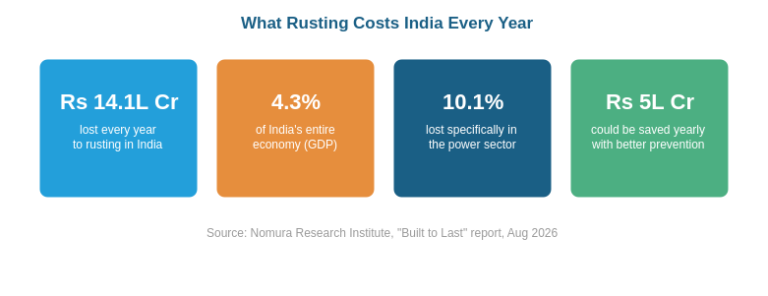
This isn’t a small problem. A recent report by the Nomura Research Institute found that rusting (corrosion) costs India ₹14.1 lakh crore every year — that’s about 4.3% of the entire country’s GDP. Power and energy infrastructure are among the hardest hit, with losses as high as 10.1% in the power sector alone. The same report says that better prevention could save India close to ₹5 lakh crore a year.
Source: Nomura Research Institute, “Built to Last: Adopting Global Best Practices to Reduce Corrosion Losses in India’s Infrastructure,” reported by Business Standard, Aug 2026.
Why Monsoon Makes Rusting Worse
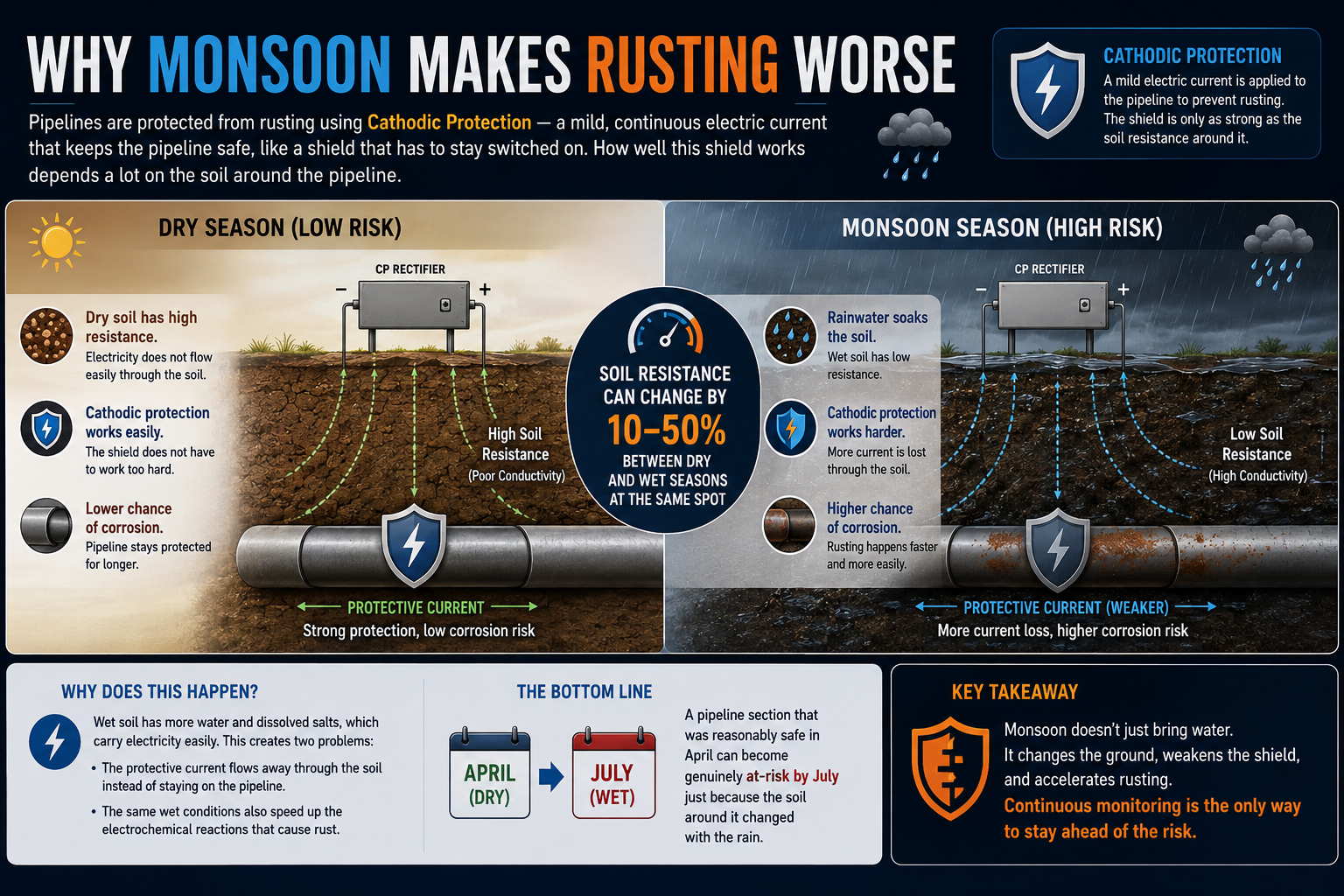
Pipelines are protected from rusting using a technique called Cathodic Protection — think of it as a mild, continuous electric current that’s sent through the pipeline to stop it from rusting, a bit like a shield that has to stay switched on. How well this shield works depends a lot on the soil around the pipeline.
Dry soil doesn’t conduct electricity well, so the shield doesn’t have to work as hard. But once monsoon rains soak the ground, wet soil conducts electricity much more easily — and that same change also makes it much easier for rust to form. Engineering studies show that the ground’s resistance to electricity can swing by 10–50% between the dry season and the wet season at the very same spot. In simple terms: a pipeline section that was reasonably safe in April can become genuinely at-risk by July, just because the soil around it changed with the rain.
The Real Problem: You Can’t Always Reach the Pipeline
Here’s what makes monsoon especially tricky. Normally, engineers check on pipeline protection equipment by physically visiting sites along the pipeline route. But during heavy rains, many of these locations get flooded, waterlogged, or simply too unsafe to travel to. So exactly when pipelines need the closest watch, it becomes the hardest time to send someone to check on them in person.
A pipeline that isn’t being protected properly usually doesn’t show any obvious signs at first. The damage builds up quietly over weeks. By the time a leak or a problem is discovered, it’s often too late to call it “just a small maintenance gap” — and in almost every case, the real cause traces back to a period when nobody was watching.
What Happens If Nobody Notices in Time
It helps to be specific about what’s actually at stake, because “corrosion risk” can sound abstract until you break it down into real consequences.
- Small leaks that grow quietly. A pinhole-sized weak spot doesn’t announce itself. Left unchecked through a wet season, it can widen into a leak that’s expensive and disruptive to repair — and in the worst cases, unsafe.
- Unplanned shutdowns. When a corrosion problem is finally discovered on-site rather than caught early on a dashboard, the fix is rarely simple. It often means digging up sections of pipeline, halting operations, and scrambling field crews on short notice — all at a much higher cost than routine monitoring would have been.
- Repeated damage in the same spots. Without a record of how each section performed in previous monsoons, the same vulnerable stretches can keep getting missed year after year, because nobody has the data to know they’re a pattern rather than a one-off.
- Safety risk near populated areas. Pipelines don’t always run through remote land — some stretches pass close to towns, farmland, or water bodies. A slow leak that goes unnoticed for weeks is a very different problem than one caught within a day.
None of this is inevitable. It’s the direct result of a monitoring gap — and monitoring gaps are exactly what remote systems are built to close.
The Solution: Watching Pipelines Without Having to Physically Visit Them
This is exactly the problem CIMCON’s remote pipeline monitoring solves. Instead of relying only on someone driving out to check equipment, we install small smart devices along the pipeline (called iRTS, or remote monitoring units) that automatically read how well each section is protected and send that information straight to a computer dashboard — day and night, rain or shine.
This isn’t just a concept — CIMCON has already done this at a large scale. We built a remote pipeline-protection monitoring system for Indian Oil Corporation Limited (IOCL), covering a 3,000 km gas pipeline. Instead of depending on manual, site-by-site visits, the entire network is now watched continuously from one central dashboard.
What This Looks Like in Everyday Terms
- Round-the-clock readings — instead of checking a pipeline once a month, the system checks it constantly, automatically
- Instant alerts — if something looks wrong, the team gets notified right away instead of finding out weeks later on the next scheduled visit
- One dashboard for the whole pipeline — engineers can see the health of the entire route at a glance, and send field teams only where they’re actually needed
- A running history — the system remembers how each part of the pipeline behaves every monsoon, so problem spots can be predicted before they happen
- Less dependence on physical access — teams don’t need to reach every single site in person, especially during the months when it’s hardest to do so
Getting Ready for Monsoon, the Smart Way
Operators who sail through monsoon season without nasty surprises aren’t the ones with the biggest field teams — they’re the ones who can see what’s happening on their pipeline without needing to send someone out to look. Remote monitoring turns monsoon risk from a last-minute scramble into something you can plan for well in advance, because you already know which parts of the pipeline need attention before the rain even stops.
If you’re reviewing your own monsoon readiness this year, a few simple checks go a long way before the rains set in:
- Confirm every monitoring point is actually online. A monitoring system is only useful if every unit along the route is reporting properly — it’s worth a quick check before the season starts, not during it.
- Look back at last year’s monsoon data. If certain sections showed weaker protection readings last year, they’re the ones most likely to need attention again this year.
- Set clear alert thresholds. Make sure the system is set up to flag a problem the moment it happens, not just record it for someone to notice later.
- Plan field visits around the data, not a fixed calendar. Rather than visiting every site on a routine schedule, prioritize the ones the dashboard is already flagging as borderline.
A Few Common Questions
Does remote monitoring completely replace physical inspections?
No — and it isn’t meant to. What it does is tell you exactly which sites genuinely need a visit, so field teams spend their limited monsoon-season time where it actually matters, instead of checking every location on a fixed schedule regardless of risk.
Is this only useful during monsoon?
Not at all. Continuous monitoring is valuable year-round — it’s simply that the gap between “what the pipeline needs” and “what field teams can physically check” becomes widest during monsoon, which is when the benefit is most visible.
How long does it take to set up on an existing pipeline?
It depends on the length and layout of the network, but because the monitoring units are added onto existing infrastructure rather than requiring it to be rebuilt, most projects can move from planning to full visibility well within a single season.
To learn more about how this technology works more broadly, explore CIMCON’s Oil & Gas monitoring solutions.
Ready to Monsoon-Proof Your Network? → Explore the Smart Water platform: Smart Oil & Gas – CIMCON Software India PVT LTD → Talk to our team about monsoon readiness: Book a discovery call → Learn more about CIMCON Automation: cimconautomation.com |