
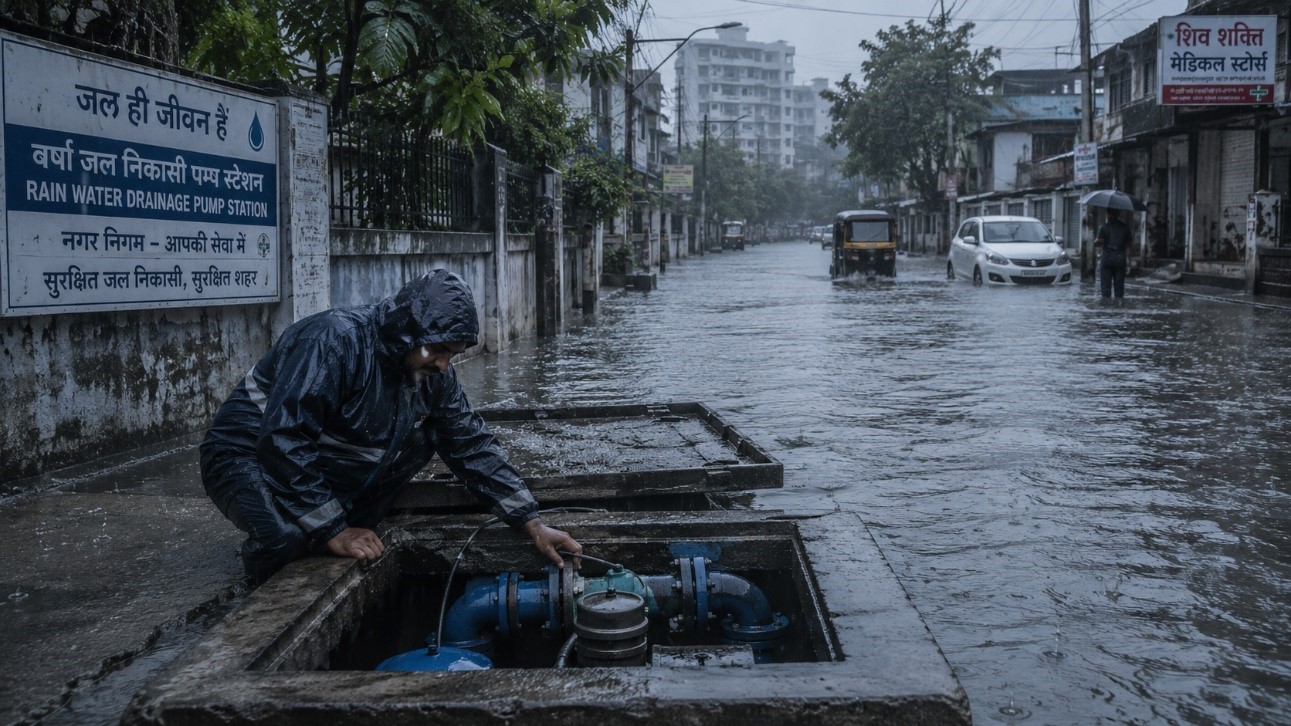
The first drops of rain bring relief after months of scorching summer. Children rush outdoors, farmers welcome the much-needed showers, and cities breathe easier as temperatures fall. But within a few hours of relentless rainfall, the story begins to change.
Roads disappear beneath water. Traffic slows to a crawl. Low-lying areas flood, power interruptions become common, and municipal teams race against time to respond to emergencies. For citizens, it means delayed commutes and waterlogged streets. For water utilities, it marks the beginning of one of the most challenging seasons of the year.
Let say It’s 3:47 a.m. in a mid-sized Indian city. The rain has been falling for eleven hours straight. A pressure sensor at the Zone-4 pump house has been offline since midnight nobody knows. A distribution main under a busy market road has been leaking since last night’s downpour softened the soil around a decades-old joint. Nobody knows that either.
By 8 a.m., the WhatsApp complaints start rolling in. Muddy tap water in three colonies. No supply in two others. And somewhere in a control room, an engineer is trying to explain to the Municipal Commissioner why the utility didn’t see this coming.
Every June, this scene repeats itself across Indian cities not because engineers aren’t working hard (they are, often through the night), but because they’re being asked to protect thousand-kilometre networks with tools built for calmer weather.
For water utilities, monsoon isn’t just a weather event. It’s the annual audit that infrastructure, staff, and reporting systems all take at once. And the utilities that come through it smoothly aren’t the ones with the newest pipes. They’re the ones who can see what’s happening in their network in real time rain or shine. That’s the promise behind CIMCON’s Smart Water platform.
According to Survey: What the Data Says
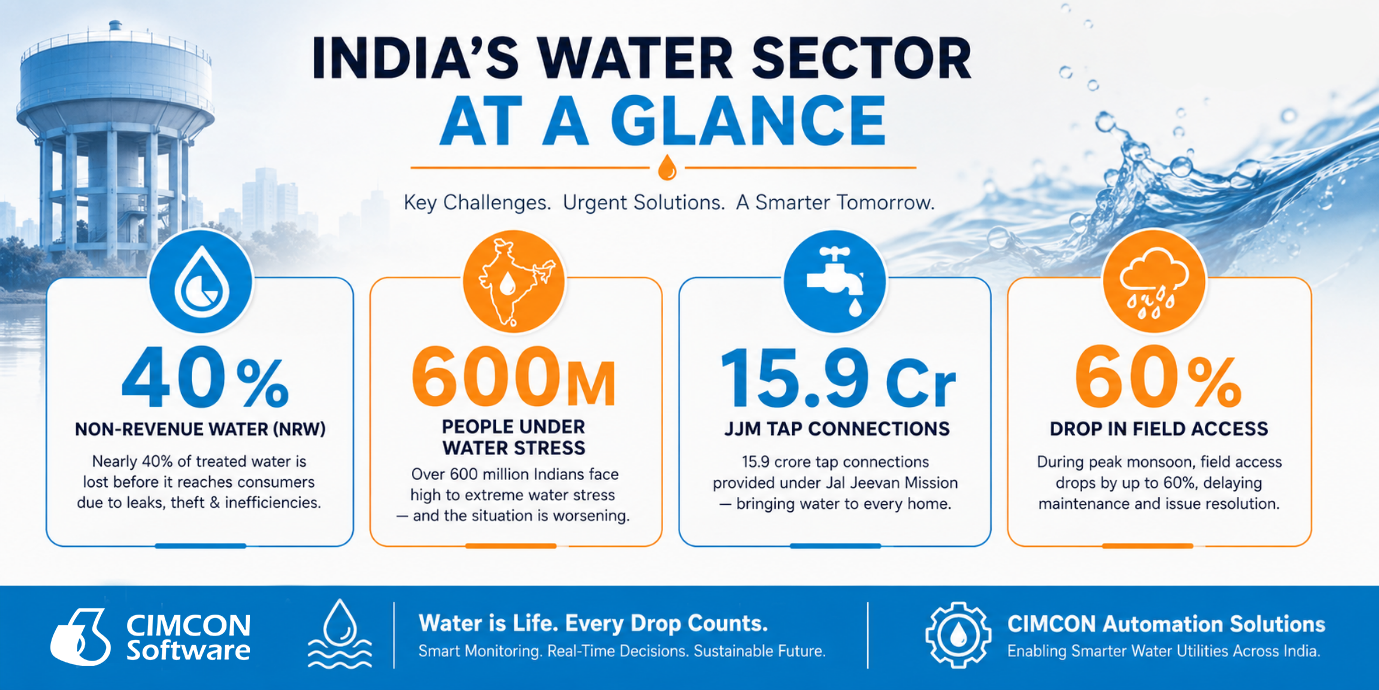
India’s water sector is under structural pressure long before the first cloud rolls in. A few figures policymakers and utility heads are already tracking:
- India loses an estimated 38–40% of the water it supplies as Non-Revenue Water (NRW) — through leakage, unauthorised use, and metering losses — well above the global benchmark of 15–20% for well-run utilities. (World Bank & CPHEEO benchmarks)
- Nearly 600 million Indians face high-to-extreme water stress, and 21 major cities were flagged as being at risk of severe groundwater depletion in the widely-cited NITI Aayog Composite Water Management Index. Source: NITI Aayog CWMI Report
- Over 9 crore rural households now have functional tap water connections under the Jal Jeevan Mission — but sustaining supply reliability, water quality, and NRW targets requires continuous monitoring, not periodic manual checks. Source: Jal Jeevan Mission Dashboard
- The India Meteorological Department has flagged rising monsoon variability — heavier, shorter cloudbursts followed by dry spells — which pushes stormwater and drainage systems past their design assumptions, dragging water supply infrastructure down with them.
Now overlay that with a three-month window where field access can shrink by more than half, and it becomes clear why utilities that plan only for “normal conditions” get caught out every year. The question isn’t whether the network will be tested. It’s whether anyone will be watching when it happens.
Why Monsoon Breaks Traditional Water Management
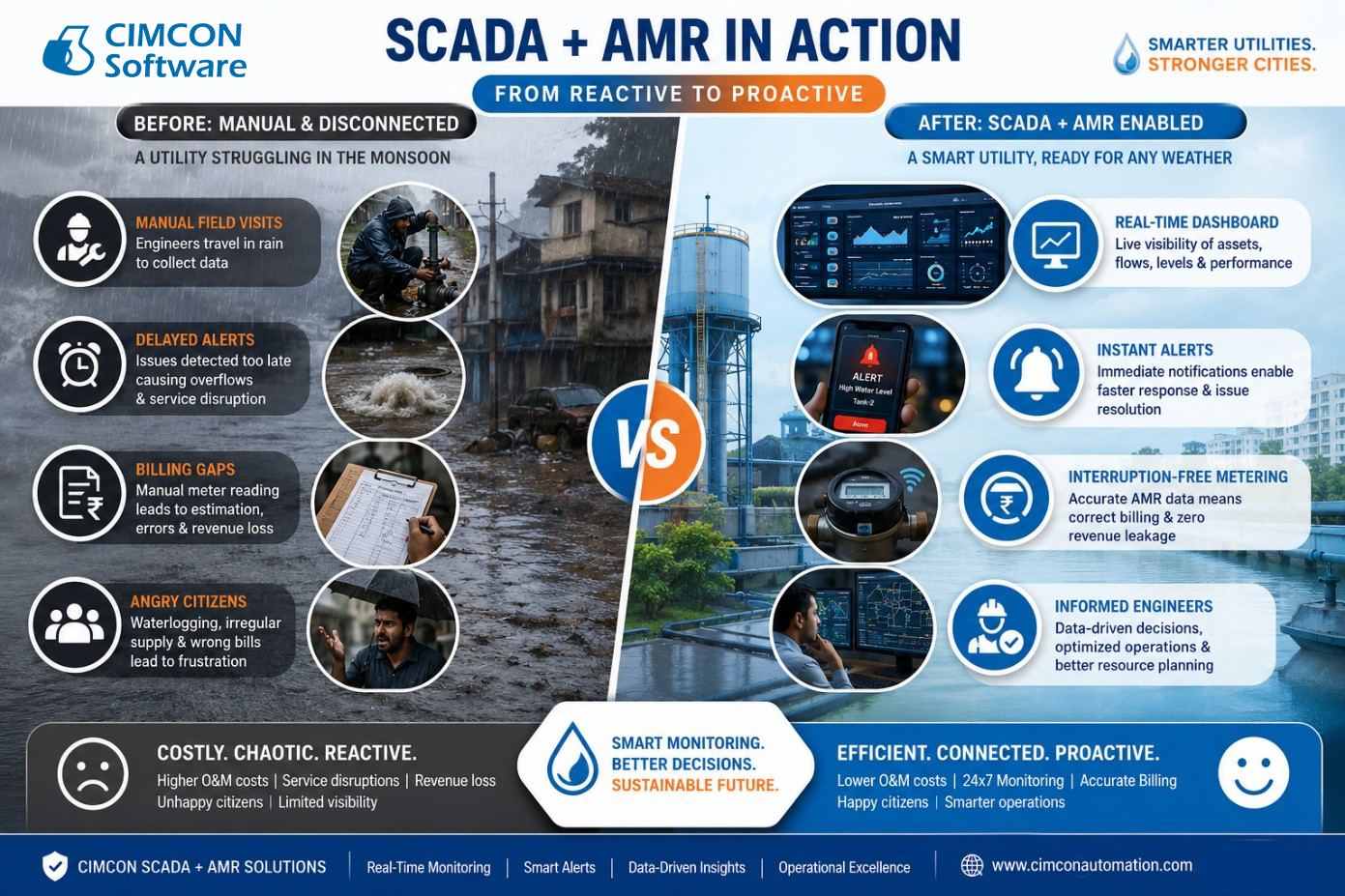
Most Indian water networks still rely heavily on manual processes — physical meter reads, periodic pressure checks, complaint-driven maintenance. It works, barely, in dry weather. Monsoon exposes every weak point at once:
- NRW quietly spikes. Underground leaks that were invisible in summer become active pathways for contamination as soil saturates and pipe joints shift under waterlogged pressure.
- Manual meter reading becomes impossible. Flooded streets and inaccessible chambers create weeks-long billing blackouts and data gaps that are almost impossible to reconstruct later.
- Power and connectivity fail exactly when you need them most. Pump stations lose grid power, communication towers go down — the blindfolding happens precisely at the moment of greatest risk.
- Contamination risk rises sharply. Cross-connections and pipe damage during flooding let sewage and surface runoff enter the supply — often undetected until residents fall ill.
- Every hour of delay compounds the cost. A pump failure noticed on Day 2 instead of Hour 2 can multiply water loss, infrastructure damage, and repair cost tenfold.
The pattern is consistent: the utilities getting blindsided every monsoon are the ones still depending on someone being physically present to notice.
What Changes When Your Network Can Speak for Itself
CIMCON’s Smart Water & SCADA solution is built around one simple idea: your network should tell you when something’s wrong — before your citizens do.
- Remote, real-time monitoring that doesn’t need road access. Pressure, flow, and level readings stream continuously from the field. A pump house on a flooded outskirt is just as visible on your dashboard as one next to the utility office.
- AMR that keeps working when your team can’t. No dependency on physical rounds. No billing blackout during weeks when manual reads are impossible. No angry customers when the bills catch up two months later.
- Early leak & NRW detection — not after-the-fact discovery. Pressure anomalies and flow discrepancies get flagged the moment they emerge, so a developing leak is caught while it’s still a maintenance job — not a monsoon crisis on the front page.
- Built for connectivity and power gaps. Field devices are hardened for exactly the conditions monsoon creates — intermittent power, patchy connectivity — with local data buffering that resumes transmission automatically when the signal returns.
- Alerts that reach people, not just dashboards. When something crosses a threshold, the right engineer gets notified — SMS, email, mobile — so response is measured in minutes, not the next weekly inspection round.
From Reports to Reality: What This Looks Like on the Ground
Pilibhit — Where Water Reliability Reaches the Last Village
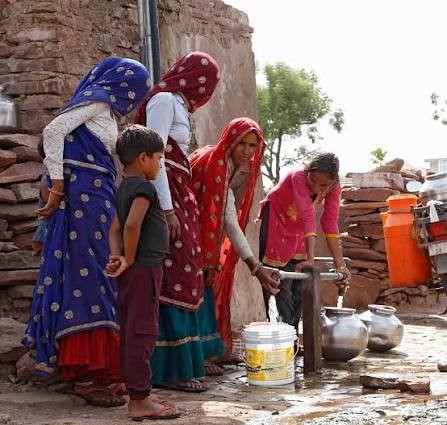
Monsoon often creates a paradox in many parts of India. Rivers overflow, fields remain waterlogged, and villages receive abundant rainfall yet thousands of families continue to struggle for a reliable supply of safe drinking water.
This was one of the key challenges addressed under the Jal Jeevan Mission in Pilibhit, Uttar Pradesh. Despite seasonal rainfall, many rural communities faced water scarcity due to uneven distribution, limited visibility into water infrastructure, delayed fault detection, and the operational challenges of managing hundreds of geographically dispersed villages.
To overcome these challenges, a centralized smart water monitoring system was implemented by CIMCON to provide real-time visibility across the rural water network. Live data from pumping stations, overhead reservoirs, flow meters, and critical assets enabled operators to monitor the complete distribution system from a central control room.
Chandigarh 24×7 Supply Meets 24×7 Monitoring
Chandigarh’s ambition of moving toward 24×7 pressurised water supply is the kind of goal that only works if it’s measurable in real time. You cannot promise citizens continuous supply if you find out about a pressure drop from a phone call.
Continuous visibility into district metering areas, pumping stations, and consumer end-points is quietly proving that a well-instrumented network doesn’t just improve monsoon response — it improves every day. NRW gets easier to track. Water audits stop being annual guesswork. Complaints get answered with data, not apologies.
For municipal engineers watching Chandigarh’s numbers, the takeaway is simple: continuous monitoring pays for itself in normal months; in monsoon months, it pays for itself many times over. Read more in our water utility case studies.
The Bigger Picture: AMRUT 2.0 and JJM Don’t Pause for Rain
AMRUT 2.0 and Jal Jeevan Mission targets are tied to supply reliability, water quality assurance, and NRW reduction. Central funding tranches, state-level performance rankings, and citizen service metrics all keep moving forward — even when field access doesn’t.
A three-month monsoon gap in your data isn’t a small operational hiccup; it’s a gap in your compliance record, your tender eligibility, and your credibility with the next reviewer. Real-time monitoring isn’t just an operational safeguard during monsoon — it’s what keeps your mission reporting and central-scheme performance intact when everything else is under water.
Conclusion: Don’t Wait for the Next Monsoon to Expose the Gaps
Every year, monsoon writes the same story about India’s water utilities. And every year, a small but growing number of utilities are quietly rewriting their part of it with sensors that don’t sleep, networks that speak back, and dashboards that see what the field engineer can’t reach.
The technology exists. The policy framework is pushing for it. The funding routes — JJM, AMRUT 2.0, state Smart City missions — are aligned. The only real question left is whether your utility will spend another monsoon reacting, or start the one after that in control.
The CIMCON Smart Water & SCADA Solution
CIMCON’s Smart Water solution is purpose-built for Indian water utilities operating at scale — combining ruggedised field devices, real-time SCADA, AMR/AMI, and analytics on a single platform. From Jal Jeevan Mission village-level installations to city-scale 24×7 supply monitoring, it’s engineered to see what your team can’t, so your team can act before your citizens have to complain.
Ready to Monsoon-Proof Your Network? → Explore the Smart Water platform: cimconautomation.com/smart-water → Talk to our team about monsoon readiness: Book a discovery call → Learn more about CIMCON Automation: cimconautomation.com |
Because the next monsoon isn’t a question of if. It’s already on the calendar.