
A story about the invisible money burning over India’s streets every night —
and the small panel on a feeder pillar that has quietly begun to pay it back.
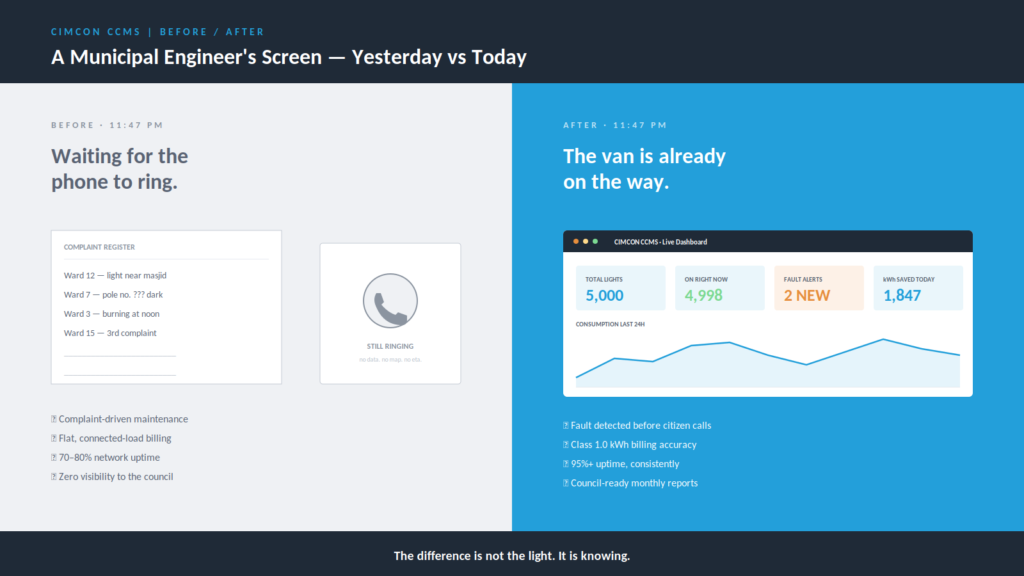
It is 11:47 PM in a district office somewhere in central India. The city outside is quiet. Most of its streetlights are on. Some, as usual, are not. A few, inexplicably, have been burning since noon.
The engineer on duty will not know which is which until sunrise, when the first complaint call arrives. A van will be dispatched. A pole will be found, and eventually fixed. The cost of the fuel, the crew, the wasted daylight-hour electricity, and the citizen who will now warn friends about that street for a week — will hide, quietly, inside the annual maintenance budget.
Multiply that story by every city, every night, every year. That is where the ROI story of smart street lighting begins.
The Signal Nobody Was Reading
The International Energy Agency’s smart-city analysis lays out the scale of what is at stake. Globally, street lighting can consume up to 65% of a municipality’s electricity budget. Only 3% of the world’s 320 million streetlight poles are smart-enabled — even though smart lighting can cut electricity use by as much as 80% through adaptive control.
Read the IEA analysis →
For India, the gap is even more striking. Since 2015, EESL’s Street Lighting National Programme has replaced over 1.36 crore conventional streetlights with LEDs — delivering roughly 9,031 million kWh in annual savings and putting approximately ₹5,400 crore back into municipal budgets.
See the SLNP dashboard →
LEDs solved the first question. The second one is where the real ROI is still hiding.
LEDs answered: how do we spend less energy per light? Smart street lighting answers a bigger one: how do we stop paying for lights that are not needed, not working, or not being measured? The technology that answers this is called a Centralized Control and Monitoring System — a CCMS.
When the Lights Start Talking Back
A CCMS panel sits at a feeder pillar and supervises 30 to 120 streetlights as a single group. It decides when they come on and turn off. It measures actual energy consumption, kilowatt-hour by kilowatt-hour. It notices when a light fails before any citizen does. And it reports all of this to a cloud dashboard the municipal engineer can watch from any device.
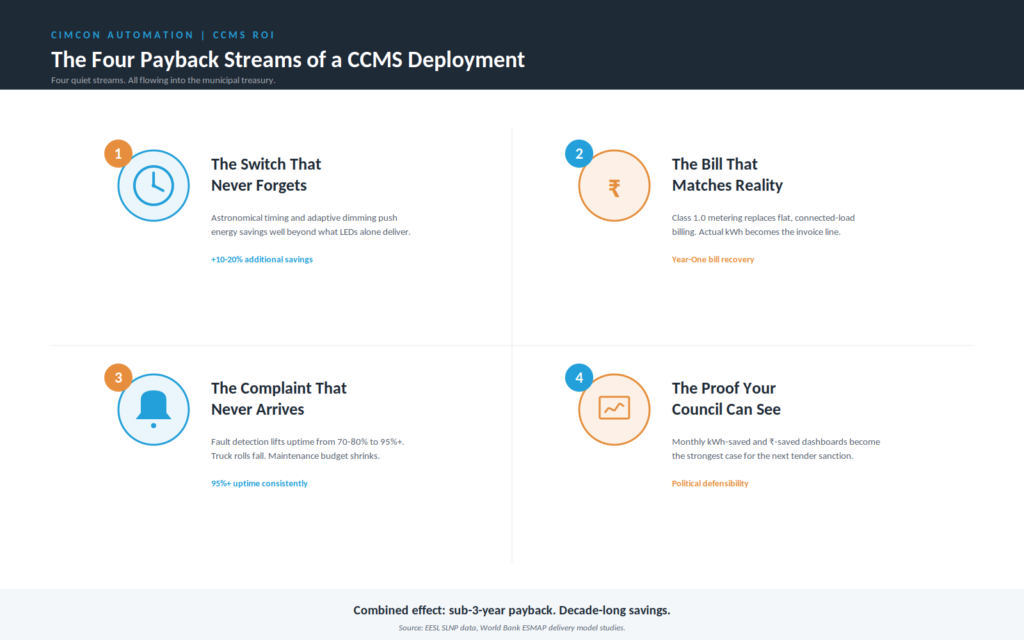
The World Bank’s ESMAP programme has documented a decade of these payback patterns across cities in developing economies, and the story is remarkably consistent: sub-3-year payback, decade-long savings. See the World Bank findings →
The Math, In One Paragraph
Consider a mid-sized Indian city with 5,000 streetlights. Before CCMS, its annual streetlight energy bill runs into about ₹3.5 crore. After CCMS is layered on top of LED — through scheduling, dimming, accurate metering, and dropped truck rolls — the same city typically sees that number fall to under ₹1 crore. The deployment pays back its own cost in roughly two to three years. Every year after that is straight benefit to the city, for the full remaining life of the infrastructure.
The commissioners who move first lock in the savings first.
The ones who wait are, quite literally, watching the money burn overhead every night.
Where CIMCON's CCMS Fits Into the Story
CIMCON Automation has been designing and deploying CCMS solutions for Indian cities from the earliest days of this transition.
Explore our Smart Street Lighting solution →
Our panels are engineered for the conditions Indian networks actually operate in — 4G connectivity that holds through weak-signal zones, automatic phase-shifting that keeps groups running when one phase fails, surge and short-circuit protection built for Indian power quality realities, and Class 1.0 metering that stands up to DISCOM audits without a challenge. Behind every panel sits a live cloud dashboard — every light, every feeder, every kilowatt-hour, in real time. Fault alerts the moment they happen. Monthly reports commissioners can walk into council with.
Cities working with CIMCON typically move from a small pilot to full-city deployment within 12 to 18 months. The journey starts on a single feeder. It ends with a city that finally knows what its streetlights are doing — and can prove, in rupees, exactly what that knowledge is worth.
It is 11:47 PM again. Different city. Same country. The engineer on duty is not waiting for a phone call this time. His screen is showing him every one of the city’s 5,000 streetlights, live. Two of them, on the eastern arterial road, have gone dark in the last five minutes. He is already dispatching a van, before the first citizen has even noticed.
Conclusion
For Indian cities still running streetlight networks on manual switches and complaint calls, the ROI question has already changed shape. It is no longer ‘will this pay for itself?’ — the IEA, the World Bank, the SLNP, and every ULB balance sheet since 2015 have answered that.
The real question is now this: how much of the payback has already been forfeited to another year of delay?
Every night the traditional network keeps running, a quiet invoice is being issued. The commissioners who deploy CCMS first are the ones who stop paying that invoice. The lights are already talking. The only question is whether your city is ready to listen.
Ready to Write the Same ROI Story for Your City?
Whether you are building a business case for a council presentation, evaluating a tender response, or just running the numbers for your own ULB — the CIMCON smart lighting team is one click away.